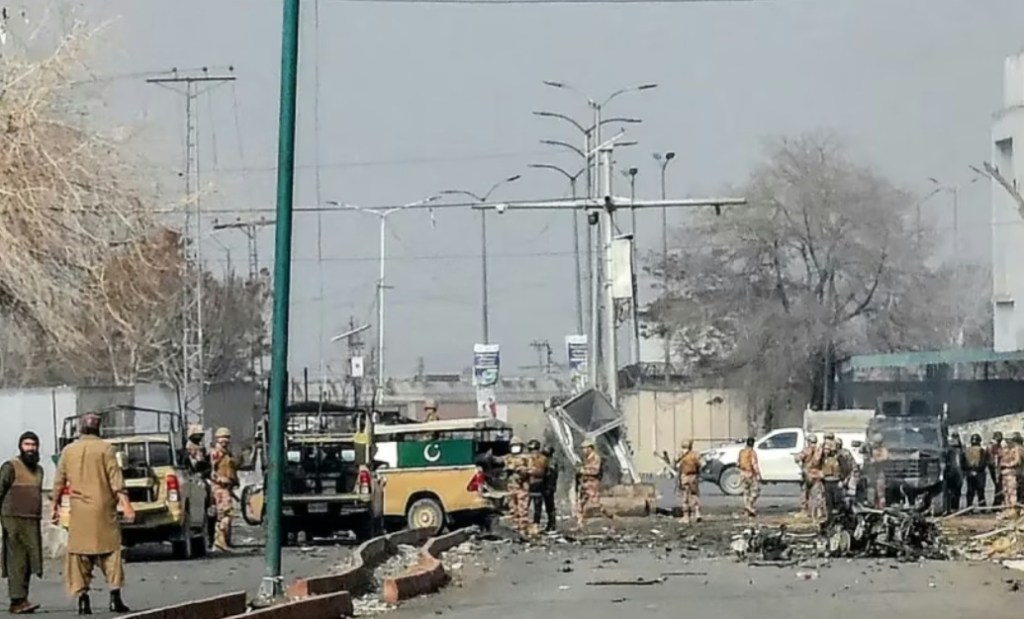
Balochistan, Pakistan — January 31, 2026: A wave of coordinated militant attacks struck numerous districts across Pakistan’s southwestern province of Balochistan in the early hours of Saturday, leaving scores dead and critically injuring many others in some of the most intense insurgent violence seen in years.
Reports from officials and local media indicate that militants, led by the Baloch Liberation Army (BLA), launched coordinated assaults on security and civilian targets from Gwadar to Quetta, Nushki, Mastung, Dalbandin, Kharan and other scattered locations across the province.
According to reports multiple districts were attacked nearly simultaneously. The assaults hit police stations, Frontier Corps (FC) posts, highways and two high-security prisons. Officials said at least 10 security personnel — including police and FC troops — were martyred in fierce gunbattles. They also claim that the security forces killed at least 67 militants engaged in retaliatory attacks and clearance operations reported. At least 11 civilians, including women and children, were reported killed in attacks in different areas. Thec militants attacked a prison in Mastung district, freeing about 30 inmates before reinforcements secured the facility.
Officials in Quetta confirmed that security forces conducted clearing and pursuit operations amid heightened alerts across the province. The Interior Ministry and provincial government condemned the attacks and pledged a robust response.
Claim of Responsibility
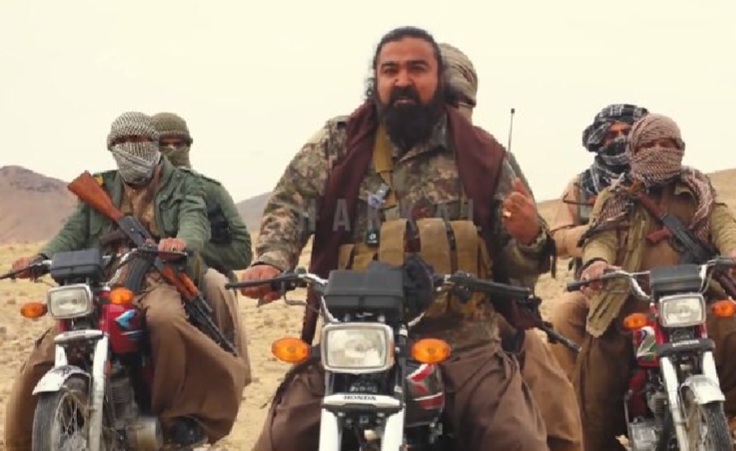
Baloch Liberation Army (BLA) — a banned separatist organisation proscribed as a terrorist group by the Government of Pakistan and the United States — claimed responsibility for the offensive, dubbing it part of the second phase of “Operation Herof” against Pakistani state institutions.
Background: The Long Baloch Insurgency
Balochistan, Pakistan’s largest province by area, has been the site of a long-running insurgency spanning decades. Ethnic Baloch separatist groups, including the Balochistan Liberation Army (BLA), Majeed Brigade and Baloch Liberation Front (BLF), have periodically taken up arms seeking separation from the federal government.
Baloch nationalist parties allege political marginalisation, economic underdevelopment and resource exploitation (notably of natural gas and minerals). However, while major political parties tend to resolve the issues through peaceful struggle, the hard-core element overtly purpose the goal of separation from Pakistan.
Sardar Akhtar Mengal, President of Balochistan National Party, in an X post soon after the attacks, said: “None of us take any pleasure in seeing our province in flames, but this should be a serious wake up call for both the authorities and the federal government.”
Pakistan’s federal government reject the charge of political and economic exploitation of Balochs and claims that the banned outfits are Indian proxies receiving financial and logistic support from India. Pakistan also claimed that Baloch insurgents are using Afghanistan’s soil for training and plotting attacks.
The insurgency has ebbed and flowed over the years, influenced by shifting local political dynamics and regional geopolitics. Islamabad has repeatedly alleged cross-border support for Baloch militants from foreign intelligence services — accusations denied by neighbouring states.
Baloch separatist tendency apart, experts also see the violent insurgency in Balochistan in the context of Gwadar Port and China-Pakistan Economic Corridor – both projects liable to give a visible geopolitical and geo-economic edge to China. Besides the global power game, regional interest are also believed to contribute the episode. If developed to its full capacity, Gwadar Port is poised to undermine Iran’s Chabahar Port and UAE’s Dubai ports. In recent days, pro-Pakistan social media handles had alleged that UAE was abetting insurgency in Balochistan.
As if the other factors were not sufficient, the entry of the United States almost ignited the powder keg. America not only signed a deal for mining of rare earth metals in Balochistan with Pakistan government but it also declared the BLA and Majeed Brigade as proscribed terrorist organizations.
Historically, the militans have carried out ambushes, bombings and sabotage — primarily targeting security forces and infrastructure — but the scale and coordination of the January 31 attacks mark one of the most complex operations to date. Previous high-profile incidents linked to the BLA include the Khuzdar school bus bombing (May 2025) that killed children and civilians, and the Jaffar Express train hijacking (March 2025) that resulted in dozens of deaths.
Impact of Today’s Assaults
Security and Governance
Though the extensive strikes across Balochistan could not be expected to have been undertsken for gaining terrotorial control yet the scale and coordination of the attacks suggest a new level of capability among insurgent cells, raising concerns about growing organisational coordination and planning capacity among separatist networks. The simultaneous targeting of varied infrastructure — prisons, police stations, highways — indicates significant tactical planning.
The ability of militants to infiltrate multiple districts almost simultaneously will likely prompt a major reassessment of security posture in the region.
 Eurasia Post
Leave a comment